My friend Christina asked me to help her choose between a couple different lenses that are what many consider to be walkaround lenses. No one lens can do everything, but a walkaround lens is a term used to describe a good all purpose lens for times when you may only want to bring a single lens with you.
So what is the best walkaround lens? Unfortunately there is no one answer, and it depends greatly on how you shoot the most, and also on budget. This topic has been hotly debated online, so here's my take on it. Hopefully this helps! Keep in mind, I'm a Canon guy! Remember the best is not always the cheapest... But I'll go over a few expensive, as well as cheaper options. I'll start off with one of the biggest debates you'll see online... Canons 24-105 f4L IS vs Canon 24-70 f2.8L

This is the Canon 24-105 f4L IS, retailing at about $1000 new. 24-105mm is an excellent focal range for a walkaround lens... Wide enough to take group shots or shots of things very close to you at the 24mm end, and long enough to zoom into things fairly far away at the 105mm end. Keep in mind that a 24-105mm lens is only truly 24-105mm on a full frame camera (ie a Canon 5D), if you own a cropped sensor camera (also referred to as an APS-C camera, i.e. Canon Rebel, 40D, 50D, 60D, etc), 24-105mm scales up to a 38-168mm (must multiply by the 1.6 crop factor to get true focal length)... This may be a little long for a walkaround lens depending on your taste. The constant f4 aperture is pretty wide (constant meaning you can open up to f4 at both the 24mm and the 105mm ends, not the case for all lenses), but indoors and in darker conditions f4 may not always get you fast enough shutter speeds to stop action, requiring you to use flash, or crank up the ISO which lowers image quality. However, the IS in the lens name stands for Image Stabilization, which helps counteract camera shake from a handheld camera and let's you shoot at slower than normal shutter speeds and still get sharp results. Image quality is excellent on this lens, I owned it at one point. Build quality is professional, as you should expect from an L series professional lens. Also notable is that the 24-105 is pretty light, which may or may not be a big deal for you.
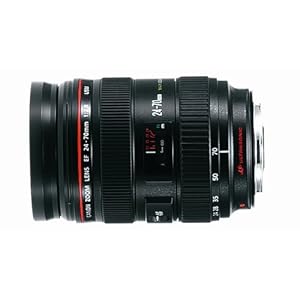
Above is the Canon 24-70 f2.8L, retailing at about $1300... Slightly higher than the 24-105. 24-70mm is still a great general purpose focal length on a full frame camera (38-112mm on an APS-C camera), although the 24-105 gives you a little more zoom capability. The constant f2.8 aperture is very wide, an f2.8 aperture gathers twice as much light as f4. This allows for better low light shots with shutter speeds more likely to stop action without need for flash. The 24-70 is a bread and butter lens of most wedding photographers, where much of their work involves taking pictures of moving subjects in dimly lit reception halls. The wide f2.8 aperture will also give you the ability to create a shallower depth of field, so you can more easily create photos with blurry backgrounds. However the 24-70 does not have the IS feature that the 24-105 has. I have also owned this lens, image quality is also top notch. Build quality is also professional level. Notable is that this lens is big and HEAVY if that is an issue for you. I should also note that the lens hood design is much better on this lens than the 24-105... Not going to go into the physics and geometry of why this is here so just trust me on that, and if you're really interested why email me.
So which of these two bad boys is better??? That's a tough question! As far as focal length, the 24-105 is is obviously more versatile than the 24-70 since is zooms all the way to 105. For low light shots, is it better to have the wider f2.8 aperture of the 24-70, or the image stabilization of the 24-105? Well, image stabilization lets you take sharp pictures in dim light at slower shutter speeds, but it only helps for static scenes (nothing moving). For moving subjects, you need the wider f2.8 to achieve shutter speeds fast enough to stop action. There's some physics involved to explain more, but I'm not going to go into those details here.
If you tend to shoot in bright light (outdoors), you prob don't need the f2.8 aperture of the 24-70. If you shoot landscape and want large depth of field so your whole scene is sharp front to back, you will usually be closing your lens down to f16 and smaller and again don't need the f2.8 of the 24-70. If you want to take shots of people indoors or in low light conditions... You will probably want the f2.8 aperture of the 24-70. If you like portraits with blurry backgrounds, you will again want the f2.8 of the 24-70. For my shooting style, I opted for the 24-70 over the 24-105. If you've been debating between these two lenses, I hope this helped!
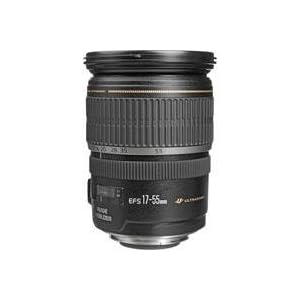
Above is the Canon 17-55 f2.8 IS, retailing at about $1000. It can almost be thought of as the best of both worlds between the 24-105 and the 24-70 described above, since it has both a wide f2.8 aperture, as well as image stabilization. Very important is this lens will ONLY work on an APS-C camera body so when using the 1.6 crop factor this lens scales up to a 27-88mm, a great general purpose focal range. Although this is not an L series professional lens, the glass used in it is very similar, if not the same, so the image quality is also L series quality. It is not built as solid as an L series lens however, but still well constructed. If you have an APS-C camera (rebel, 60D, etc), I'd say this lens is hard to beat as a walkaround lens. The main drawbacks are that the build quality is not professional L series, and secondly if you ever decided to upgrade your body to a full frame camera, you will have to sell this lens and buy a 24-70L or a 24-105L, as the 17-55 will not work on a full frame camera.

Above is my current walkaround lens, the Canon 35mm f1.4L, retailing at $1300. It is a prime lens, since it has a fixed 35mm focal length. If you're like me and value image quality over convenience of zoom, get this lens! I find 35mm to be a good general purpose focal length on my full frame camera. It's wide enough to take group photos or photos of close subjects... And if I need to take pictures of things further away... I just zoom with my feet! This lens scales to 56mm on an APS-C camera... In my opinion a little too long for a general purpose lens. The f1.4 aperture is EXTREMELY wide, allowing me to take pictures in very low light without flash, and an aperture this wide gives me really beautifully blurred backgrounds. Image quality as amazing, as prime lenses take higher quality photos in terms of color, contrast, saturation, ans sharpness. The biggest disadvantage to this lens is if I need a longer focal length, I have to change lenses, which is a pain. If you require to quickly zoom in and out, this is not the lens for you.

Above is the Canon 17-40 f4L, retailing at $750. A little cheaper than the above options, but not cheap. It is actually one of Canons cheapest L series lenses. On an APS-C camera, this lens scales up to a 27-64mm, a great general purpose focal length. However on a full frame camera, 17mm is considered not just wide, but ultra wide... You will see some crazy near fisheye distortion in the pictures at 17mm... So not the best walkaround lens for full frame users. The f4 aperture is decently wide, but it will struggle in lower light and flash will sometimes be needed. No image stabilization here. Image quality is top notch, as well as build quality as you would expect from a L series lens. I own this lens, my first L lens! I still have it and love it on my full frame camera when I need to shoot WIDE.
Canon also makes several cheaper consumer grade lenses that fit the bill for a walkaround lens. If $500 is more your budget, I heard the Canon 17-85 f4-5.6 is decent, I have not used it before. Maximum aperture on this lens is not very wide though, so you will need flash for lower light conditions. Also, if youre just starting out, the 18-55 kit lens that comes with most cameras (not to be confused with the much more expensive, higher quality 17-55) is good enough to learn on, although image and build quality are not the greatest. There are also several non-Canon brand walkaround lenses out there that I'm not too familiar with, so you may want to look into Sigma and Tamron for cheaper options.
Wow this ended up being way longer than I expected. If you're still awake and reading this, hope it helped!


No comments:
Post a Comment